Posts

Showing posts from December, 2012

Organization of a Microprocessor-Based System
Image
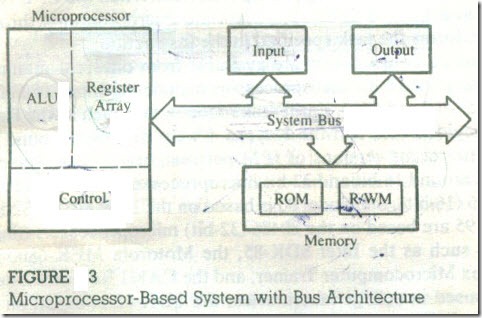
Organization of a Microprocessor-Based System Figure 3 shows a simplified but formal structure of a microprocessor-based sys­tem or a product. Since a microcomputer is one among many microprocessor ­based systems, it will have the same structure as shown in Figure 3. It includes four components: microprocessor. input, output; and memory (Read/Write Mem­ory and Read-Only Memory). These components are organized around .a common communication path called a bus. The entire group of components is also referred to as a system or a microcomputer system, and the components themselves are referred to as sub-systems. At the outset, it is necessary to differentiate between the terms microprocessor and microcomputer because of the common misuse of these terms in popular literature. The microprocessor is one component of the microcomputer. On the other hand, the microcomputer is a complete computer similar to any other computer, except that the CPU functions of the microcom­puter are performed by...

MICROPROCESSORS

Image
MICROPROCESSORS A microprocessor is a multipurpose, programmable logic device that reads binary instructions from a storage device called memory , accepts binary data as input and processes data according to those instructions, and provides results as output . A typical programmable machine can be represented with three components: mi­croprocessor. memory, and 110 as shown in Figure 1. These three components work to ether or interact with each other to perform a given task; thus, they­ comprise a system .The physical components of this system are called hardware . A set of instructions written for the microprocessor to perform a task is called a program, and a group of programs is called software, The machine (system) rep­resented in Figure1. can be programmed to turn traffic lights on and off, com­pute mathematical functions, or keep track of a guidance system. This system may be simple or sophisticated, depending on its applications, and it is recognized ­by various names depend...

Microprocessors, Microcomputers, and Assembly Language

Image
Microprocessors, Microcomputers, and Assembly Language this topic is concerned primarily with microprocessor architecture in the context of microprocessor-based products. The microprocessor-based systems are discussed in terms of three components the microprocessor, mem­ory, and input and output and their commu­nication process. The role of the programming languages, from the machine language to high-level languages, is presented in the context of the system. The material is presented in a format sim­ilar to the view from an airplane preparing lo land. As the plane circles, one observes a view without any details. As the plane descends, one begins to see the same view but with more de­tails. Chapter I presents the microprocessor from two points of view: the microprocessor as a programmable embedded device in a product and as an element of a computer system, and how it communicates with memory and I/O. The chapter also discusses the role of assembly language in microprocessor-base...

The Z80 and the 8051

Image
The Z80 and the 8051 To see the differences in concept between a microprocessor and a micro­controller, in the following table we will examine the pin configurations, archi­tecture, and instruction sets for a 1980s-era 8-bit microprocessor, the Zilog Z80, and a microcontroller, the 8-bit Intel 8051: Note that the point here is not to show that one design is "better" than the other,- the two designs are intended to be used for different purposes and in dif­ferent ways. For example, the Z80 has a very rich instruction set. The penalty that is paid for this abundance is the number of multi-byte instructions needed, some 71% of the total number. Each byte of a multi-byte instruction must be fetched from program memory, and each fetch takes time ; this results in longer program byte counts and slower execution time versus single-byte in­structions. The 8051 has a 62% multi-byte instruction content; the 8051 pro­gram is more compact and will run faster to accomplish simila...

Microprocessors and Microcontrollers

Image
Microprocessors and Microcontrollers Readers who have no prior concepts of computer operation should read Chapter 4 now. Microprocessors and microcontrollers stem from the same basic idea, are made by the same people, and are sold to the same types of system designers and programmers. What is the difference between the two? Microprocessors A microprocessor, as the term has come to be known, is a general-purpose digital computer central processing unit (CPU). Although popularly known as a "computer on a chip," the microprocessor is in no sense a complete digital computer. Figure .1 shows a block diagram of a microprocessor CPU, which contains an arithmetic and logic unit (ALU), a program counter (PC), a stack pointer (SP), some working registers, a clock timing circuit, and interrupt circuits. To make a complete microcomputer, one must add memory, usually read­ only program memory (ROM] and random-access data memory (RAM], mem­ory decoders, an oscillator, and a num...

Microprocessors and Micro controllers

Microprocessors and Micro controllers objectives On successful completion of this chapter, you will be able to: • List the differences between microcontrollers and microprocessors. • Describe the prominant standard features of a typical microcontroller. • Name several contemporary microcontroller manufacturers and notable features of their products. • Identify the major components of a microcontroller development system. Introduction The past three decades have seen the introduction of a technology that has radically changed the way in which we analyze and control the world around us. Born of parallel developments in computer architecture and integrated circuit fabrication, the microprocessor, or "computer on a chip," first became a commercial reality in 1971 with the introduction of the 4-bit 4004 by a small, unknown company by the name of Intel Corporation. Other, more well-established, semiconductor firms soon followed Intel's pioneering technol­ogy so ...