Posts

Showing posts with the label introduction to microprocessors

SUMMARY Of Microprocessors, Microcomputers, and Assembly Language

SUMMARY The various concepts and terms discussed in this chapter are summarized below: Computer Structure · Digital Computer-a programmable machine that processes binary data. It includes four components: CPU (ALU plus control unit), memory, input, and output. · CPU -the Central Processing Unit. The group of circuits that processes data and provides control signals and timing. It includes the arithmetic/logic unit, registers, instruction decoder, and the control unit. · ALU -the group of circuits that performs arithmetic and logic operations. The ALU is a part of the CPU. · Control Unit -The group of circuits that provides timing and signals to all operations in the computer and controls data flow. · Memory -a medium that stores binary information (instructions and data). · Input -a device that transfers information from the outside world to the computer. · Output -a device that transfers information from the computer to the outside world. Scale of Integration ...

MICROPROCESSOR INSTRUCTION SET AND COMPUTER LANGUAGES

Image
MICROPROCESSOR INSTRUCTION SET AND COMPUTER LANGUAGES Microprocessors recognize and operate in binary numbers. However, each micro­processor has its own binary words, instructions, meanings, and language. The words are formed by combining a number of bits for a given machine. The word (or word length), as defined earlier, is the number of bits the microprocessor rec­ognizes and processes at a time. The word length ranges from 4 bits for small, microprocessor-based computers, to 32 bits for such large computers as the IBM ES 9000 series. Another term commonly used to express word length is byte. The ,byte is defined as a group of eight bits. For example, a l6-bit microprocessor has a word length equal to two bytes. The term "nibble," which stands for a group of four bits, is also found in popular computer magazines and books. (A byte has two nibbles.) TABLE 1 Microcomputer Applications   The instruction is defined as a complete task (such as Add) the microproces­...

How Does the Microprocessor Work?

Image
How Does the Microprocessor Work? Assume that a program and data are already entered in the RJW memory. (How to write and execute a program will be explained later.) The program includes binary instructions to add given data. and to display the answer at the seven­ segment LEUs. When the microprocessor is given a command to execute the program, it reads and executes one instruction at a time and finally sends the result to the seven-segment LEDs for display. This process of program execution can best be described by comparing it to the process of . assembling a radio kit .The instructions for assembling the radio are printed in a sequence on a sheet of paper. One reads the first instruction, then picks up the necessary components of the radio and performs the task. The sequence of the process is read. Interpret , and perform, The microprocessor works the same way. The instructions are stored sequentially in the memory. The micro­processor fetches the-first instruction from its memo...

Organization of a Microprocessor-Based System

Image
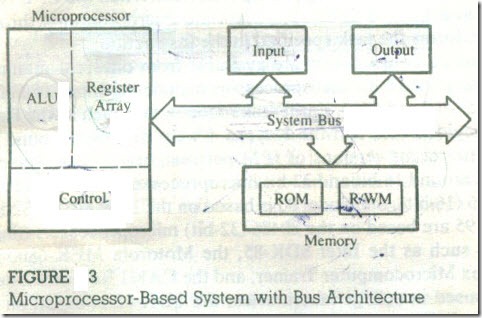
Organization of a Microprocessor-Based System Figure 3 shows a simplified but formal structure of a microprocessor-based sys­tem or a product. Since a microcomputer is one among many microprocessor ­based systems, it will have the same structure as shown in Figure 3. It includes four components: microprocessor. input, output; and memory (Read/Write Mem­ory and Read-Only Memory). These components are organized around .a common communication path called a bus. The entire group of components is also referred to as a system or a microcomputer system, and the components themselves are referred to as sub-systems. At the outset, it is necessary to differentiate between the terms microprocessor and microcomputer because of the common misuse of these terms in popular literature. The microprocessor is one component of the microcomputer. On the other hand, the microcomputer is a complete computer similar to any other computer, except that the CPU functions of the microcom­puter are performed by...

MICROPROCESSORS

Image
MICROPROCESSORS A microprocessor is a multipurpose, programmable logic device that reads binary instructions from a storage device called memory , accepts binary data as input and processes data according to those instructions, and provides results as output . A typical programmable machine can be represented with three components: mi­croprocessor. memory, and 110 as shown in Figure 1. These three components work to ether or interact with each other to perform a given task; thus, they­ comprise a system .The physical components of this system are called hardware . A set of instructions written for the microprocessor to perform a task is called a program, and a group of programs is called software, The machine (system) rep­resented in Figure1. can be programmed to turn traffic lights on and off, com­pute mathematical functions, or keep track of a guidance system. This system may be simple or sophisticated, depending on its applications, and it is recognized ­by various names depend...